
From click to copied position
In brief
This page follows one copy from the first tap to a position on the follower's account, using the help pages of cTrader Copy read on 6 November 2026. It adds three examples of arithmetic with made-up numbers, and a table of the cases in which the pages say a trade is not copied. Where the pages end, it says so.
Two accounts, one rule
The provider trades on their own account, which the help pages call the strategy account. The investor's allocated money sits on a different account, the copy-trading account. The rule linking the two is the equity-to-equity ratio: the volume of a copied trade is the investor's equity divided by the provider's equity, multiplied by the provider's volume.
That is the whole decision the platform makes about size. It makes no judgement about whether a trade is good, and it takes no instruction from the investor about individual trades.
From the tap to a position, as the help page lists it
The steps follow the help page on investing in strategies and the overview page. Sources: help.ctrader.com/ctrader-copy/investing-in-strategies and help.ctrader.com/ctrader-copy, read on 6 November 2026.
| Step | What the pages say happens | Where the money is |
|---|---|---|
| 1. Choose | A strategy is selected from the list and Start copying is tapped. The fees show on that button. | Still in the investor's account |
| 2. Allocate | An account is chosen and an amount entered, equal to or above the strategy's minimum investment; terms are confirmed. | Still in the investor's account |
| 3. Move | The allocated funds are deposited into a separate copy-trading account under the same cTrader ID, used for that one strategy only. | In the copy-trading account |
| 4. Catch up | The strategy's existing open positions are opened for the copy-trading account at current market rates, and later actions are copied. | In the copy-trading account |
| 5. Repeat | Each provider trade is copied, sized by the equity ratio; changes the provider makes to open positions are copied too. | In the copy-trading account |
| 6. Stop | Copying is stopped at any time; open copied positions are closed and the funds go to the main account. | Back in the main account |
What the steps leave open
The first step mentions fees on the Start copying button, and that button sits inside the application, which this site did not enter. Step four says existing positions are opened at current market rates. A position the provider opened some time ago was opened at the price of that time, so the investor's entry price differs from the provider's from the first minute. The help page states the general warning in one line: prices may differ due to variations in trading conditions and execution time.
Three worked examples, with invented numbers
These numbers are made up to show the arithmetic of the help page's formula (investor's equity divided by provider's equity, times the provider's volume). They describe no account and no strategy.
| Case | Provider's equity | Investor's equity | Provider opens | Copy size |
|---|---|---|---|---|
| Plain ratio | USD 25,000 | USD 2,000 | 1.5 lots | 0.12 lots |
| A very small ratio | USD 100,000 | USD 1,000 | 0.20 lots | 0.002 lots, then the broker's step applies |
| Provider doubles equity, same open 1.5 lots | USD 50,000 | USD 2,000 | 1.5 lots still open | 0.06 lots after recalculation |
Reading the examples
In the first row the investor holds 8 percent of the provider's equity, so a position of 1.5 lots becomes 0.12 lots. In the second the ratio is 1 percent and the copy comes to 0.002 lots. If the broker's smallest allowed size is larger than that, the help page says the size is adjusted to the broker's step, and it does not say whether upward or downward. The third row shows the ratio moving without any trade: the provider added money, the denominator doubled, and the investor's share of the same open position halved.
The provider's balance moves the follower's positions
The fees page puts the same mechanic in one note: when the provider adds funds, the platform decreases the investor's positions, and when the provider withdraws, it increases them. The overview page adds a warning that a provider depositing or withdrawing with positions open can cause losses on the investors' copy-trading accounts. The investor's own deposits and withdrawals change the ratio in the same way.
Cases in which the pages say a trade is not copied or is changed
Each row is a sentence of the help pages in plain form. Sources: help.ctrader.com/ctrader-copy (overview, 'Exceptions') and help.ctrader.com/ctrader-copy/investing-in-strategies, read on 6 November 2026.
| Situation | What the pages say happens |
|---|---|
| Too little money in the investor's account | The trade is not copied. |
| The investor's account lacks the provider's instrument | The trade is not copied. |
| Investor's leverage lower than the provider's, free margin short | Trades may not all be copied; the page warns of stop out earlier than the provider. |
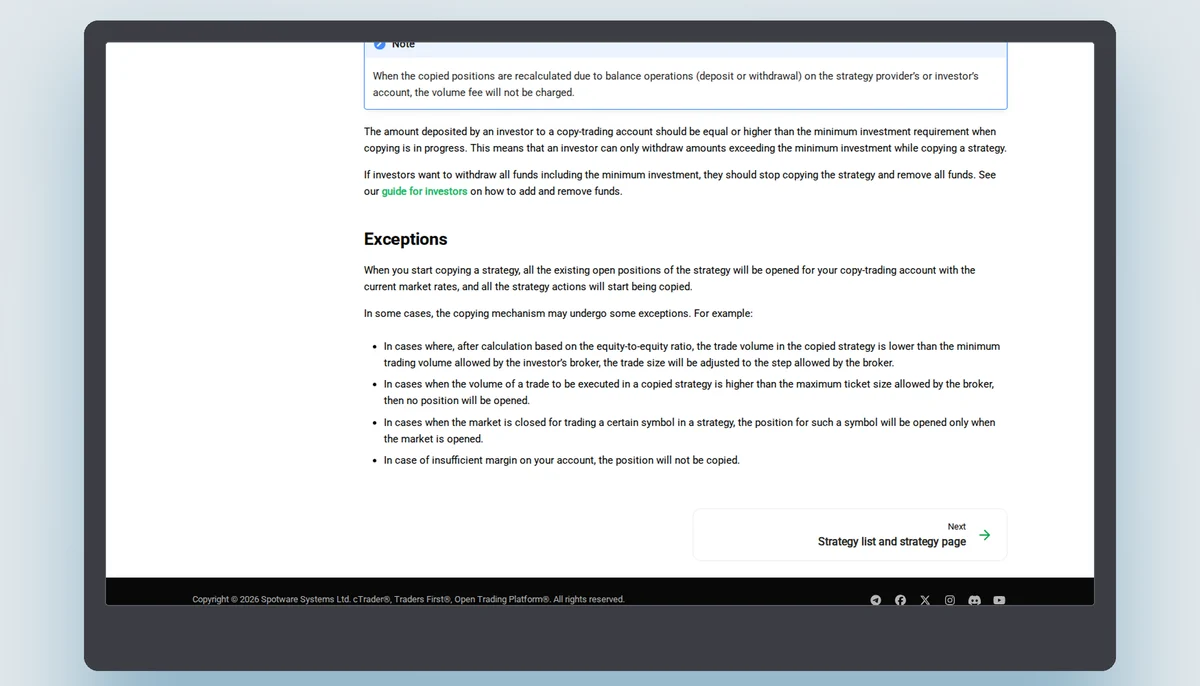
| Calculated volume below the broker's minimum | Adjusted to the step the broker allows. The page does not say in which direction. |
| Calculated volume above the broker's maximum ticket size | No position is opened. |
| The market of the symbol is closed | The position is opened only once the market opens. |
| Insufficient margin | The position is not copied. |
| Symbols that represent stocks and shares | Copying them is forbidden; the provider may trade them, investors do not copy them. |
| A netting account | Not supported; only hedging accounts can copy. |
What the exceptions add up to
A copy account does not mirror the provider's account position for position. The nine rows are the pages' own list of ways in which it can differ: money, instruments, leverage, size limits, closed markets, shares and account type. Several of them depend on the broker rather than on cTrader, which is why the platform's pages direct questions of availability to the broker.
What the investor can do afterwards
The investor can add funds, remove funds, set an equity stop loss, or stop copying. The help page states that the equity stop loss is not a guaranteed price: once it is triggered, copied positions are closed, but the final equity may be lower than the level set because of volatility, price gaps, liquidity or technical factors. Funds below the strategy's minimum investment cannot be withdrawn while copying; to take everything out, copying has to be stopped.
Read next
Questions a UAE reader asks about copying
Does the copy trade the same size as the provider?
No. It is scaled by the ratio of the two equities, then limited by the broker's minimum, step and maximum ticket size.
Can the follower pick which trades to copy?
The pages describe no such option; every provider trade is copied unless one of the listed exceptions applies.
Are shares copied?
No. Copying trades on symbols representing stocks and shares is forbidden on cTrader Copy.
Is the follower's price the provider's price?
Not necessarily. The page says prices may differ due to trading conditions and execution time.
The broker this site links to
This site links to FxPro, which cTrader's list marks as a copy-enabled broker. A copied trade is a leveraged contract on a price, not ownership of anything. Read the terms before you decide anything.