Copy trading in the UAE, as a plain map.
Three authorities are named in the Emirates for three kinds of ground, and copy trading sits across a broker, a platform and a regulator that may be none of the three. This site draws the map: what each authority is, what the public pages of cTrader Copy say about how copying works and what it costs, and where this site could read nothing. Latest reading: 6 November 2026. It does not tell you whether to copy anyone.
Six pages, each answering one question
Who regulates what
Three authorities in plain words, and the two attempts to read their pages that returned nothing.
Regulator labels on the list
What 40 printed labels on 24 entries look like when counted, and why two labels with the same letters can name different countries.
From click to position
The steps, the formula, three worked examples with invented numbers, and the cases in which nothing is copied.
What the provider is paid
Three fees with caps of 40%, 10% and USD 10, the days they are charged, and the platform's share.
The twenty cards, counted
Ages from 49 to 1,369 days, minimums from USD 100 to USD 50,000, and curves of 29 days.
Funding in dirhams
1 of 24 copy brokers list the dirham as a base currency; what that leaves for the reader to ask.
What this map is for
Copy Trading UAE is a reading desk. It reads public pages about copy trading, writes down what they say, and puts the date on every reading. The pages come from two places. The first is cTrader Copy, a copy-trading service inside the cTrader platform: its front page, its list of brokers, three symbol pages and four help pages. The second is the group of UAE authorities, whose pages this site tried to read and, for the reasons set out below, could not. The latest reading was 6 November 2026.
The site is not a broker and does not hold money. It takes no side for or against copying, and it does not say that a reader should or should not copy anyone. Where a page was silent or closed, the site says so in place of filling the gap.
Copy trading in four sentences
A strategy provider trades on their own account. An investor allocates money to that strategy, and a platform repeats the provider's trades on a separate account of the investor's, sized by the ratio of the two equities. The investor can stop at any time. The provider is paid by fees that the platform takes from the investor's account, inside caps the platform prints. The rest of this site is detail on those four sentences, and on who the authorities are around them.
Three authorities, defined and not read
The Securities and Commodities Authority, the SCA, is the federal securities authority, whose remit is the onshore market. The Dubai Financial Services Authority, the DFSA, regulates financial services in the Dubai International Financial Centre. The Financial Services Regulatory Authority, the FSRA, does so for Abu Dhabi Global Market. The reader's first question about any firm is on which of those grounds, if any, it says it stands.
Those are plain definitions. The page on who regulates what states no position of any of the three on copy trading.
What happened when the authorities' pages were requested
On 6 November 2026 the SCA's news page was requested and came back as a page shell with no list inside it. The DFSA's front page answered HTTP 403. The FSRA's pages were not requested. No UAE regulator page was read for this site. A refused or empty page says what this server received, and the site does not turn that into a statement about what an authority has or has not said.
What the broker list printed about regulators
cTrader's page of brokers held 53 entries on 6 November 2026, and 24 carried the copy flag that the page prints as "Copy available". Those 24 printed 40 regulator labels between them; 10 entries printed none. 2 entries printed "DFSA UAE", and one more printed "CMA UAE". The count of 2 is a reading of cTrader's list, not a check of the DFSA's register.
Short names that travel
The same letters appear against different places on the list: CMA beside Kenya on one entry and beside the UAE on another, and FSRA beside Saint Lucia on a third. The Cyprus regulator's name is spelled three ways across 9 entries. A reader who counts labels without reading the place beside them can end with a wrong number or a wrong country, and the page on regulator labels sets out the counts with that caution.
The one broker this site links to
FxPro's entry on the list carried a copy flag, a maximum leverage of 1:30, a minimum deposit of USD 100, and the regulators FCA UK; SCB - SIA Bahamas. FxPro quotes its instruments as contracts for difference. It does not offer shares of any exchange through this route, because cTrader Copy forbids copying trades on symbols that represent stocks and shares. Whether its copy service is open to a resident of the UAE is a question for FxPro.
How a copy is made
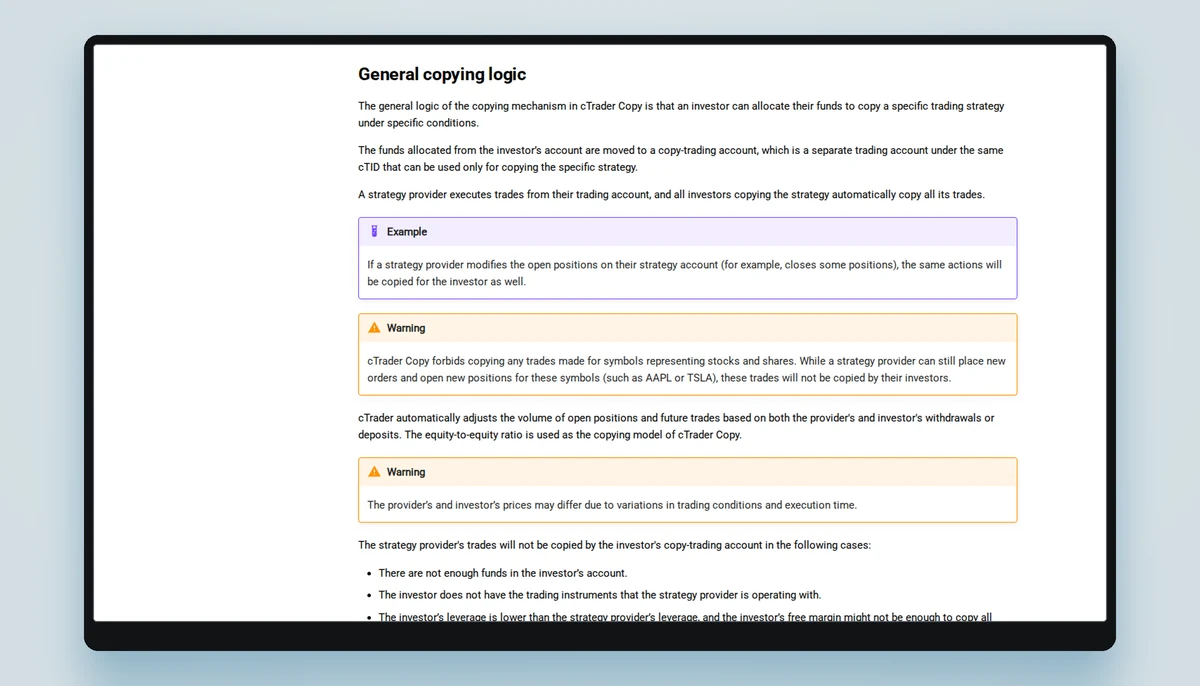
The help page defines the copied volume as the investor's equity divided by the provider's equity, multiplied by the provider's volume. Its own example has a provider with USD 4,000 opening 4 lots and an investor with USD 1,000 receiving 1 lot. With invented numbers of this site's own, USD 25,000 against USD 2,000 turns a provider's 1.5 lots into 0.12. The size is recalculated whenever either side deposits or withdraws.
When a copy differs from the provider's trade
The pages list the cases: too little money in the investor's account, an instrument the investor's broker lacks, lower leverage with too little free margin, a volume under the broker's minimum or over its maximum ticket size, a closed market, shares, and netting accounts. Prices may differ too, the help page says, due to variations in trading conditions and execution time. The follower's account is a second account that tries to follow the first.
What the provider is paid
Three fees, each with a printed cap: a performance fee of at most 40% of net profit under a high-water mark, a management fee of at most 10% of equity a year, and a volume fee of at most USD 10 per million copied. All are charged on the 1st of each month, and also when copying stops, when the investor removes funds, and when the provider stops the strategy. From 4 July 2026 the platform takes 30% of the provider's fees, which the help page says adds nothing for investors.
Costs the pages do not price
The help pages print no figure for the broker's spread, commission on trades, financing of positions held overnight, or the conversion between currencies. These are real costs of a leveraged position and of funding, and they sit in the broker's terms. A reader comparing a copy's result with the provider's has all of them to add to the fees above.
The 20 public cards, counted
The cards on cTrader's gold, bitcoin and euro pages are the same 20. Their ages run from 49 days to 1,369, and 12 are under a year old. Minimums run from USD 100 to USD 50,000. 15 list gold among their symbols. This site shows these counts and no provider's name, because the counts are what the pages let it say without ranking anybody.
Printed returns beside short curves
The printed returns run from -17% to 113,998%; 8 are 1,000% or more and 2 are negative. Beside each return a 29-day curve is drawn, from 8 October 2026 to 5 November 2026: 5 of the 20 ended below zero. The cards do not state the period of the printed return, which is why this site never calls it a result for a reader.
Dirhams and dollars
Of the 24 copy entries, 1 prints the UAE dirham as a base currency and 24 print the US dollar. FxPro's printed currencies do not include the dirham. A dirham reader therefore meets a conversion on the way in and on the way out; this site read no rate or charge, shows one example with invented numbers, and leaves the real figures to the bank and the broker.
What cTrader's own pages say about availability
The front page of cTrader Copy says that availability of live copy trading may vary by broker, jurisdiction and applicable regulatory requirements, and that each broker is solely responsible for deciding whether copy trading may be offered to its clients. The broker page adds: "cTrader Copy availability depends on local regulations and your broker. Please check with your selected broker before opening an account." None of the pages says which countries are served.
What the strategy list leaves out
The help page says: "The strategy list only includes strategies whose providers are currently trading." A strategy that has stopped is therefore not on the list, and a count of the cards cannot show how many strategies began and ended or what share lost money. Every count on this site describes the cards shown on the day they were read.
Questions to put to a broker before depositing
Which company holds the account, with its exact legal name, and under which authority and register? Is the copy service open to a resident of the UAE? Is the account a hedging account, since copying requires one? Can a demo account follow a strategy? In which currencies can the account be held, and who charges for the conversion? What is the account's leverage compared with the provider's? And what happens to the money if the provider stops the strategy? The last has an answer in the help pages: all investors stop copying, open positions are closed and unrealised fees are charged.
A short glossary
Provider: the trader whose positions are copied. Investor or follower: the account that repeats them. Equity: the account's balance with open profit and loss included. High-water mark: the highest value reached, above which a performance fee applies. Margin: the part of the account held against an open leveraged position. Stop out: the broker closing positions because the margin is no longer enough. Contract for difference: an agreement on a price change, not ownership of the thing priced. Hedging account: an account that can hold opposite positions at once, which copying requires.
When the readings were taken, and what a later reading may change
The cTrader pages were saved on 6 November 2026 within a few minutes of each other, one request at a time, and the authorities' pages were requested the same day. A later reading may differ: brokers are added to the list, cards change, a help page is revised and a blocked page may open. The date beside each figure is what makes it checkable; a figure without its reading date is not printed here.
How a figure on this site is checked
The saved pages are counted by one script and recounted by a second one that reads the files by another route; a disagreement is reported as an error. Defects planted on purpose in five places were each caught. That checks the copying of figures. It does not check that the platform's pages are right, and it does not check any register, because none could be read.
The broker this site links to
This site links to FxPro, which cTrader's list marks as a copy-enabled broker. A copied trade is a leveraged contract on a price, not ownership of anything. Read the terms before you decide anything.